Quick Take
- An abandoned baby gray titi monkey was rescued in the Colombian highlands and is being rehabilitated at the Wildlife Care and Assessment Center Fauna Silvestre with the goal of returning him to the wild.
- The infant, informally called Nuba ("cloud" in Spanish) by the staff for his soft gray fur, has latched onto a stuffed elephant toy twice his size and refuses to let go of it.
- To prevent the monkey from imprinting on humans, caretakers wear realistic titi monkey masks during every feeding and interaction so the first face he sees is always one of his own kind.
How He Was Found
In early February 2026, a farmer in the mountainous Antioquia region of Colombia discovered a tiny gray titi monkey clinging to a branch just meters above a recently cleared field. The infant was alone, dehydrated, and calling out in high-pitched distress vocalizations that are typical of separated titi monkey babies.
Gray titi monkeys (Plecturocebus cinerascens) are small, socially bonded primates found across the forests of South America. They're known for their unusually strong pair bonds - mated pairs intertwine their tails while sleeping and fathers carry infants almost exclusively for the first months of life. Finding a baby alone is almost always a sign that something has gone badly wrong.
"The surrounding forest had been partially cleared for cattle grazing," said biologist Jian Pablo Giraldo, who leads the primate program at Fauna Silvestre. "We believe the family group was displaced and the infant was either dropped during a panicked flight through the canopy or deliberately abandoned by a stressed mother. It happens when habitat destruction forces these animals into impossible situations."
The farmer contacted local wildlife authorities, who transported the monkey to the Wildlife Care and Assessment Center Fauna Silvestre in Caldas. He arrived weighing just 180 grams - barely more than a bar of soap - and was severely hypothermic. Staff warmed him in an incubator and began round-the-clock bottle feedings of specialized primate formula.
The Stuffed Elephant
Within hours of his arrival, caretakers noticed the infant was in acute distress beyond just hunger and cold. He was searching constantly - reaching out with his tiny hands, wrapping his tail around anything within reach, and producing non-stop contact calls. Titi monkeys are among the most physically affectionate primates on Earth, and infants are essentially never alone. Being without a warm body to cling to was psychologically devastating.
A staff member placed a large brown stuffed elephant toy - roughly twice the monkey's body length - into his enclosure as a surrogate. The response was immediate.
"He launched himself onto it and buried his face into the fur," Giraldo recalled. "His entire body just relaxed. The vocalizations stopped within seconds. It was like watching someone exhale for the first time in days."
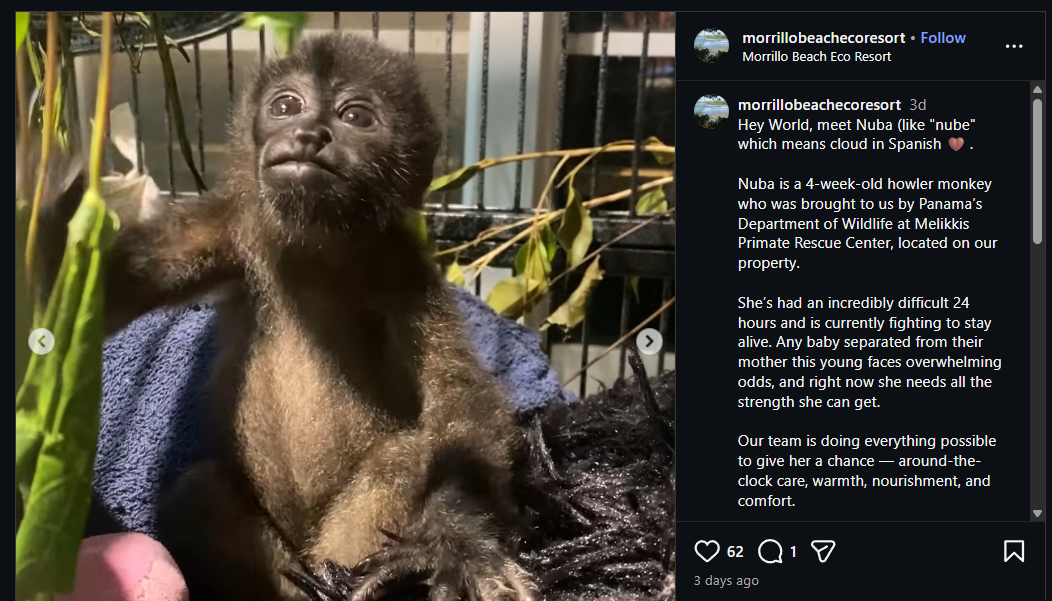
Nuba now sleeps pressed flat against the stuffed elephant toy's chest, his tail coiled around its arm. He eats while gripping its fur. If the toy is briefly removed for cleaning, he screams and searches frantically until it's returned. Staff have provided backups in case the original wears out, but Nuba shows a clear preference for his original - he can apparently tell the difference by smell.
"Titi monkeys form the strongest pair bonds of any New World primate," Giraldo explained. "In the wild, infants spend the first 3-4 months literally attached to their father's body. That stuffed elephant toy is filling the role of his father right now. It's his anchor to the world."
The Monkey Masks
The most unusual aspect of Nuba's care is something visitors never see: every caretaker who enters his enclosure wears a realistic titi monkey mask. The mask covers the entire face and is modeled after an adult gray titi, complete with the species' distinctive round eyes and soft gray facial fur.
The reason is imprinting. If the first face a baby primate sees regularly is a human face, it will come to identify humans as its own species. This makes reintroduction to the wild nearly impossible - the animal will seek out human contact instead of bonding with its own kind, and will lack the social skills needed to survive in a wild group.
"If the first thing they see when they're babies, so to speak, is a human, they'll come to believe that their herd, that their species, are humans," Giraldo said. "We can't let that happen. The goal from day one has been to get this animal back into the forest."
The masks are custom-made by a local artist who works with the sanctuary, hand-painted and fitted with mesh eye openings so caretakers can see while wearing them. Staff also wear long-sleeved neutral-colored clothing and minimize talking in Nuba's presence. Feedings are done in near-silence.
"It's awkward at first," admitted caretaker Valentina Rios. "You're bottle-feeding a tiny monkey while wearing a full face mask and trying not to make any human sounds. But when you see how he looks up at the mask face with complete trust - he thinks that's his parent. That's when you know it's working."
Road to Release
Nuba is now approximately 10 weeks old and gaining weight steadily. He's begun exploring solid foods - mashed tropical fruits and insects - alongside his formula. His grip strength is improving, and he's started making short climbing excursions around the branches in his enclosure, though he always returns to the stuffed elephant toy within minutes.
The team at Fauna Silvestre has mapped out a multi-phase rehabilitation plan. Over the next several months, Nuba will be gradually introduced to other rescued titi monkeys at the center. If he bonds with them successfully, the group will be moved to a larger outdoor enclosure that simulates forest conditions. The final stage - a soft release into a protected forest corridor in the Antioquia region - is tentatively planned for late 2026 or early 2027.
"We don't rush this," Giraldo emphasized. "A premature release is a death sentence. He needs to be physically strong, socially competent, and able to forage independently. That takes time."
The informal name Nuba - cloud - came from the night staff who noticed the infant's soft gray fur looked like a tiny storm cloud against the white stuffed elephant toy. Officially, the center avoids giving rescued animals permanent names to maintain emotional distance, but the name stuck.
"Everyone calls him Nuba," Rios admitted. "We're not supposed to get attached. But he's a baby monkey who sleeps hugging a stuffed elephant toy and thinks a mask is his father. How do you not get attached to that?"
For now, Nuba's world is small: a warm enclosure, a bottle of formula, a stuffed elephant toy that smells like home, and a series of masked strangers who love him more than he'll ever know.